
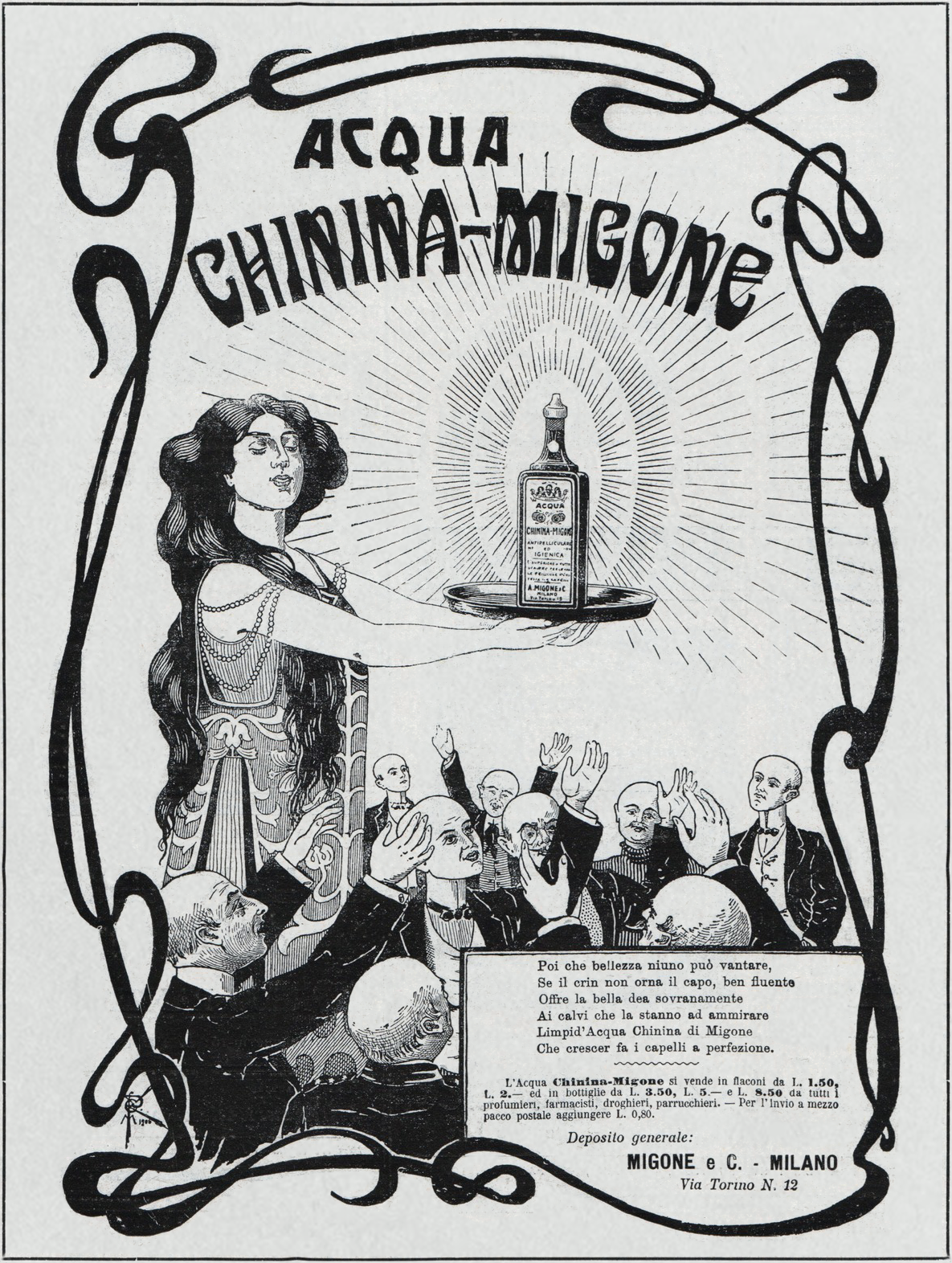
Of everything the house made across nearly two centuries, the perfumes, the soaps, the fine face powders, the product most people still search for is a hair tonic that, by everything medicine now understands, could not have done what it promised. It is worth saying that plainly, and worth saying just as plainly that it is no mark against the house. Acqua di Chinina, Migone's quinine water for the scalp, belonged to its age as completely as gaslight and the horse tram, and to understand it you have to meet it there.
To see why it sounded credible, begin with the ingredient. Quinine, chinina, is drawn from the bark of the South American cinchona, the "fever tree" whose powder Jesuit missionaries carried out of Peru in the sixteen-forties as the first true cure for malaria. For two centuries it was among the most prestigious substances in all of medicine; around 1650 the Genoese physician Sebastiano Bado judged it more precious to mankind than all the silver Spain had drawn from the Andes. When, in 1820, two French chemists isolated its active principle and named it quinine, they only confirmed what Europe already believed: that here was one of the miracle drugs of the age.
A substance with that reputation did not stay in the medicine chest. Around the middle of the nineteenth century quinine crossed to the dressing table, and quinine water for the hair became one of the great commercial categories of the era: the Paris house of Ed. Pinaud offered an Eau de Quinine in the 1850s, and within a generation scarcely a perfumer in Europe or the Americas was without one. The reasoning was not a swindler's. If the bark could break a fever, surely it could rouse an idle scalp, and there was a sensation to prove it, for quinine is astringent and faintly stinging, and to a customer that bracing tingle felt exactly like roots being called back to life.
It was, of course, doing nothing of the kind. Like the bay rum and the beetle extracts sold beside it, quinine water was a tonic in the old sense, bracing, fragrant, and a cure for nothing. No law of the period required a remedy to be proven, and none of these were. That is not a charge peculiar to Migone; it is the plain truth about an entire shelf of the nineteenth-century chemist, and by the standards of that shelf a quinine hair water was neither fraud nor folly but ordinary good sense.
What set Migone apart was not chemistry but voice. Its Acqua di Chinina was advertised with the full-throated confidence of the age, and its most quoted line, Sorgi, o Calvo, "Rise, O Bald Man," ran beside the obligatory before and after, the bare crown and the restored head of hair. That was the campaign's most memorable note, but far from its only one. The advertisements ran everywhere, for years, until promise and product were simply part of the Italian press, and it is how a great many Italians first met the word Migone: not on a flask of perfume but in a newspaper advertisement.
The scale is hard to overstate. By its own advertising the Chinina sold some five and a half million bottles a year, a "worldwide success" printed in French, English and Spanish and shipped, as the sheets boasted, to every corner of the earth. And it was sold to everyone. The same water told a woman her hair was the crown of her beauty and promised a man the same for his, beard included; it was pressed on mothers for their children and held out to the balding as a small miracle. It came perfumed, odourless, or cut with petroleum, from pharmacists, perfumers, grocers and hairdressers alike, and it made its case as readily in rhyming verse as in a doctor's language. For a tonic that did nothing, it was marketed like an empire.
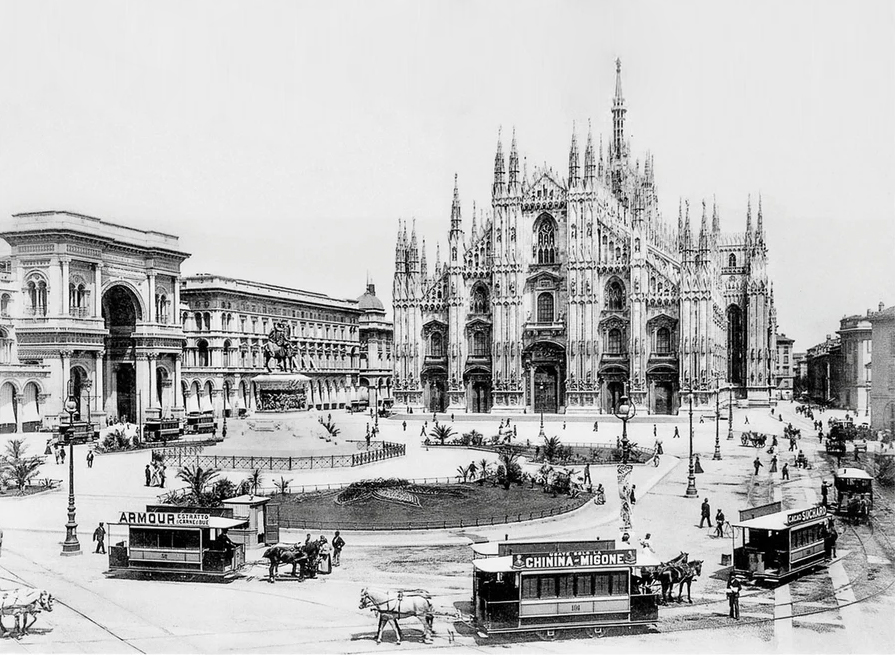
The tonic reached further than fame. When the house registered its telegraphic address, the codeword by which a firm received cables, it did not choose its own name. It chose the product's. Wires to the Via Ripamonti works were addressed to MIGONCHINA. The tonic had, in the most literal sense, become the house's name on the wire.
And the promise proved strangely durable. A quinine hair tonic is not a museum piece: walk into a pharmacy today and you will still find quinine shampoos on the shelf, sold to strengthen the hair and slow its loss, resting on evidence scarcely firmer than Migone's. The claim has grown more modest, slow the loss rather than raise the dead, but the active ingredient is the same and so is the hope. The promise turns out to have been not the end of a superstition but the beginning of one that never quite died.
Every house that lasts long enough accumulates a shelf it would no longer stock. Acqua di Chinina belongs to the real history of Casa Migone as fully as any medal or perfume, and it reads best the way it was lived: the ordinary confidence of an age that had not yet learned to ask a remedy for proof. So there is no need to admire the claim, and none to be embarrassed by it. In a time when a house lived or died by whether the public knew its name, this small brown bottle carried "Migone" into millions of ordinary lives and held it there for decades, outlasting even the house that made it: the Chinina was still sold under the Migone name into the 1960s, years after Casa Migone had closed. It never grew a single hair. It grew the name.
← Back to the Journal