

In 1778, the perfumer Angelo Migone opened a small shop in Milan. Over nearly two centuries the house grew into one of Italy's great houses of perfume and cosmetics, outliving empires, republics, and two world wars.
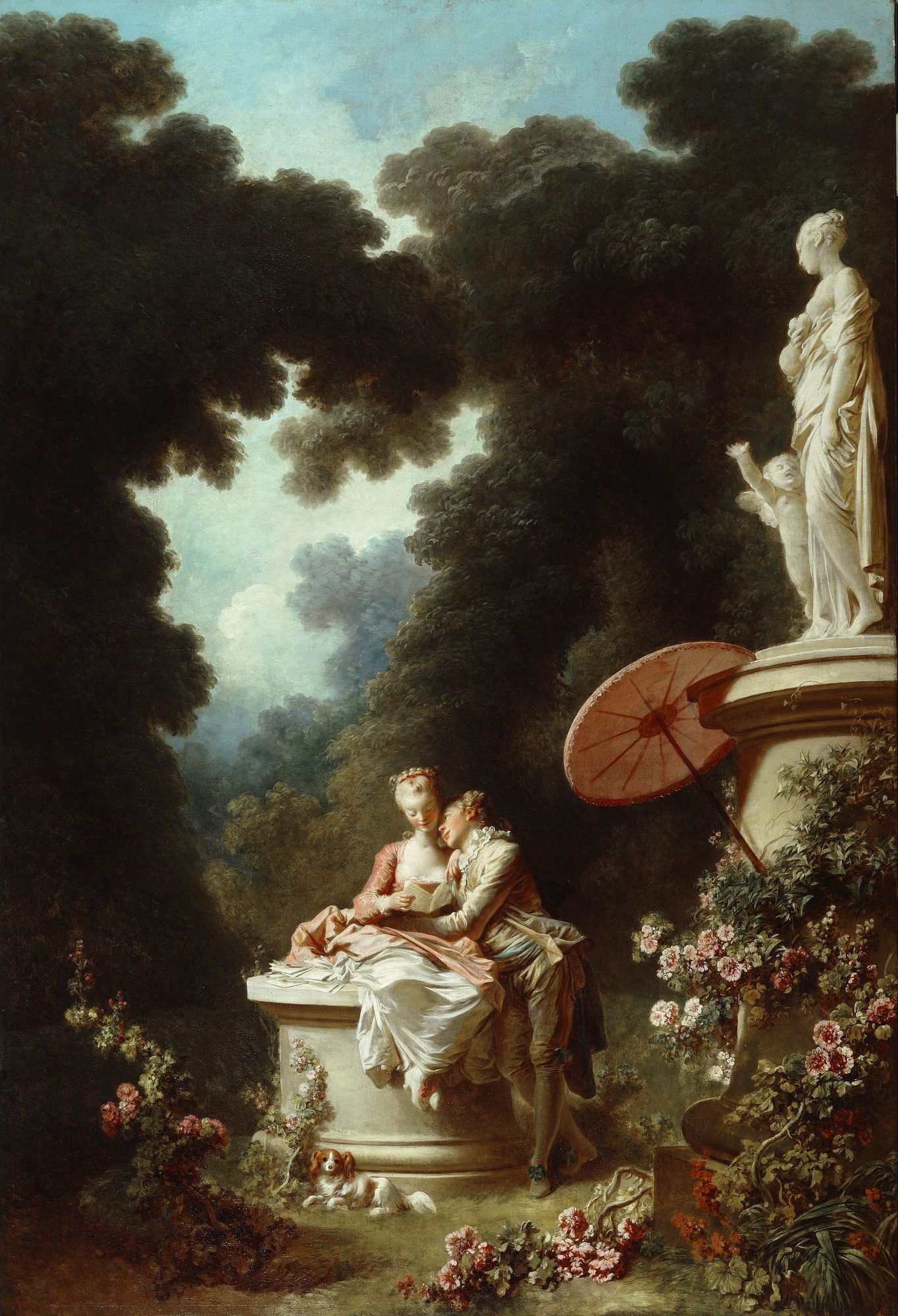 Jean-Honoré Fragonard, Love Letters, 1771–72. Frick Collection, New York.
Before the shop in Milan, there was Grasse: where Angelo came as a young man to learn his trade. The town sits in the hills of Provence in a microclimate that produces flowers of an intensity found nowhere else in Europe: jasmine, rose, orange blossom, lavender, mimosa, harvested at dawn and processed before the warmth of the day could diminish them. By the time Angelo arrived, it was the perfume capital of the world. It had not always been so: in the Middle Ages it was a tanning centre, its leather exported across Italy. But tanned leather smelled, and the gloves made from it were destined for noble hands. When a Grasse craftsman offered Catherine de' Medici a pair of perfumed gloves, she was, as the account goes, seduced on the spot. The fashion remade the town, and in 1614 Louis XIII recognized the new guild of gantiers-parfumeurs, glover-perfumers who were at once leather workers and blenders of scent.
It was this guild that Angelo came to join. The painter Jean-Honoré Fragonard came from these same streets: his father François was a glover and perfumer, a gantier-parfumeur of the same trade that now employed an entire town. By Angelo's time the workshops of Grasse produced essences that traveled from these hills to the courts and dressing tables of all Europe. Perfume was not yet something you applied to skin. You wore it in your hands: in a glove, a fan, a handkerchief. The clientele was the aristocracy that carried such things. When Angelo set off back toward Italy, he carried with him a craft built for a world that, within a few years, would no longer exist.
In 1778, Angelo opened his shop in Milan. On 3 August of the same year, Teatro alla Scala was inaugurated nearby. The Migone story and one of the city's most celebrated institutions begin together.
Milan was then the capital of Lombardy under Habsburg rule, one of the most important cities on the Italian peninsula, known across Europe for its commerce, its silk, and its reformed administration. Maria Theresa had spent decades modernizing its government and opening its trade. The Enlightenment had taken root here: Cesare Beccaria wrote On Crimes and Punishments in Milan; the city's educated merchant class was connected to the wider European world. It was not a provincial outpost. It was a stage.
Angelo had come to it from Grasse, carrying a perfumer's training honed in the scent capital of the world. The Milan he found was still a walled city, ringed by the broad Spanish ramparts you crossed only at guarded gates. The house took its first steps at their edge, on the rim of the city, before finding its place in the old heart: the Contrada de' Pennacchiari, number 3233, a few steps from the Duomo, in the city's ancient guild quarter.
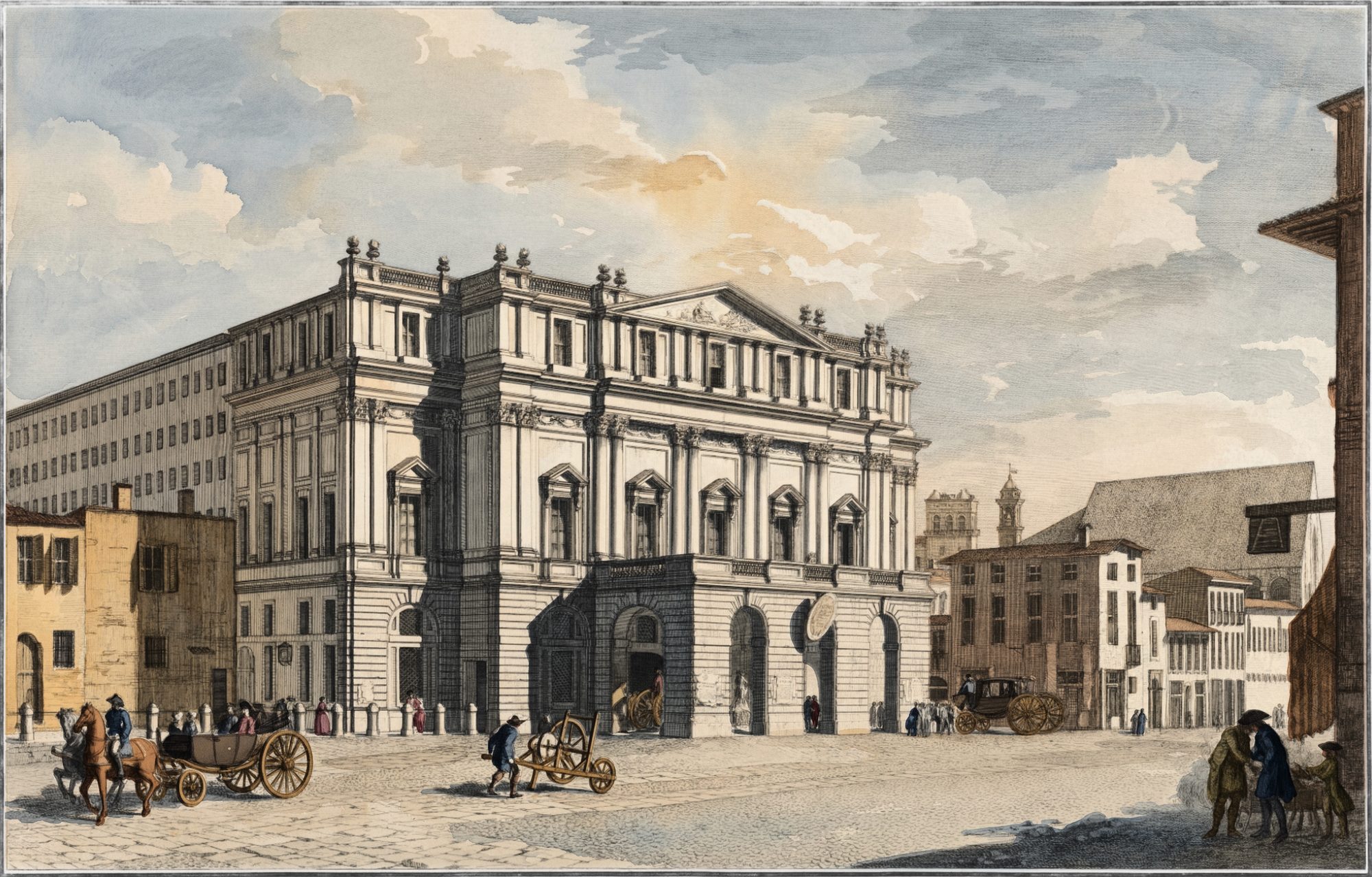 Domenico Aspari, Teatro alla Scala, 1790. Inaugurated in 1778.
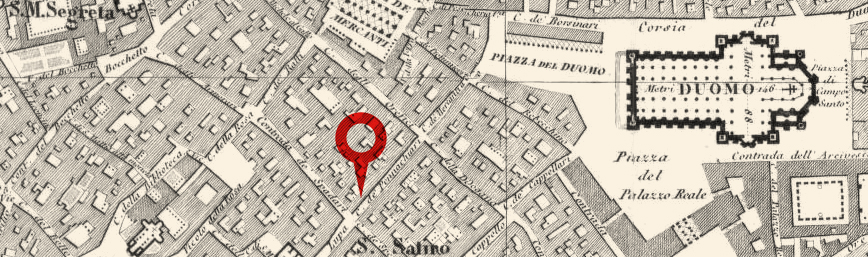 The Contrada de' Pennacchiari, with civic number 3233 marked.
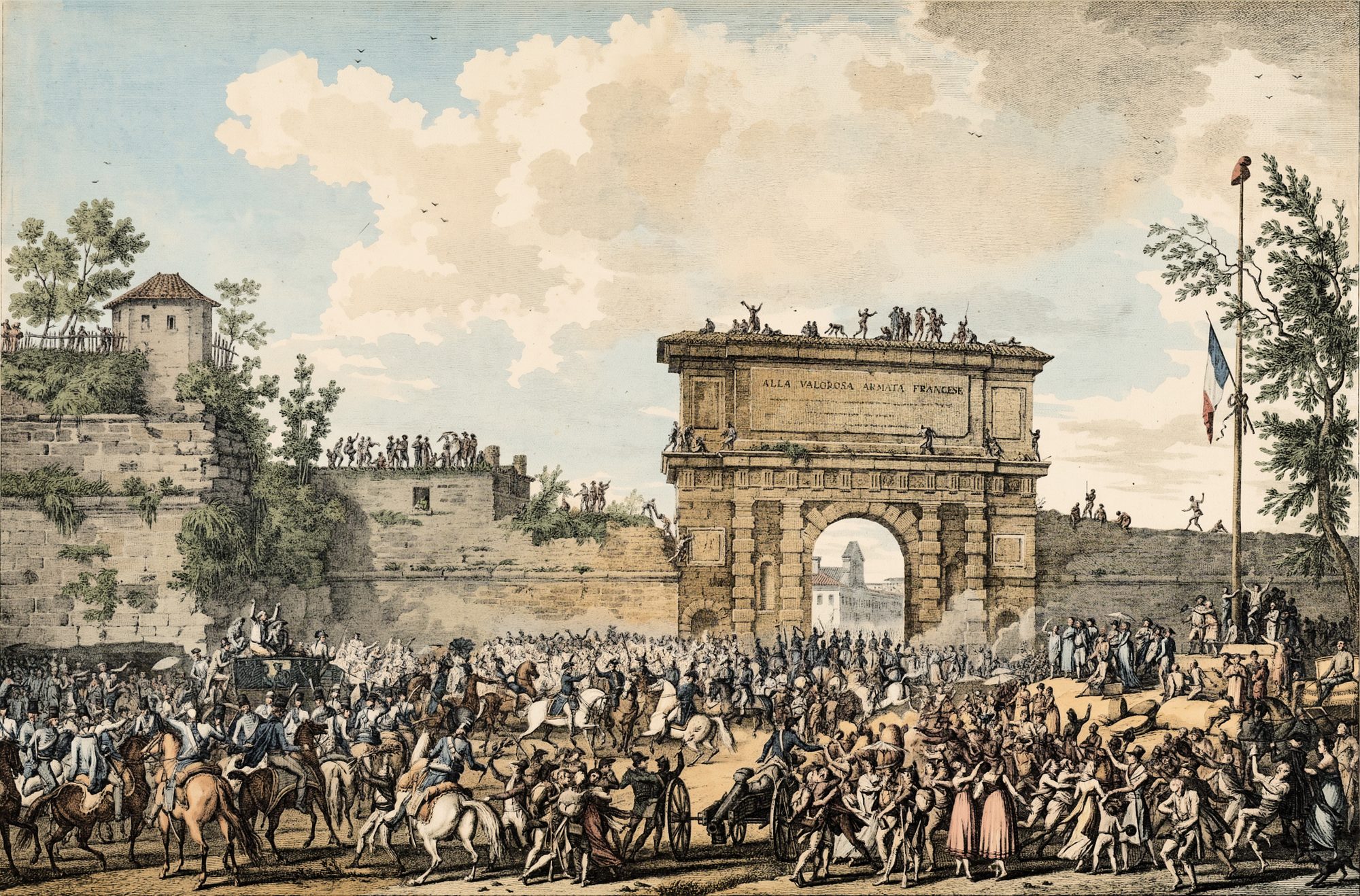 Carle Vernet, The Entry of the French into Milan, 1796 (print ca. 1850).
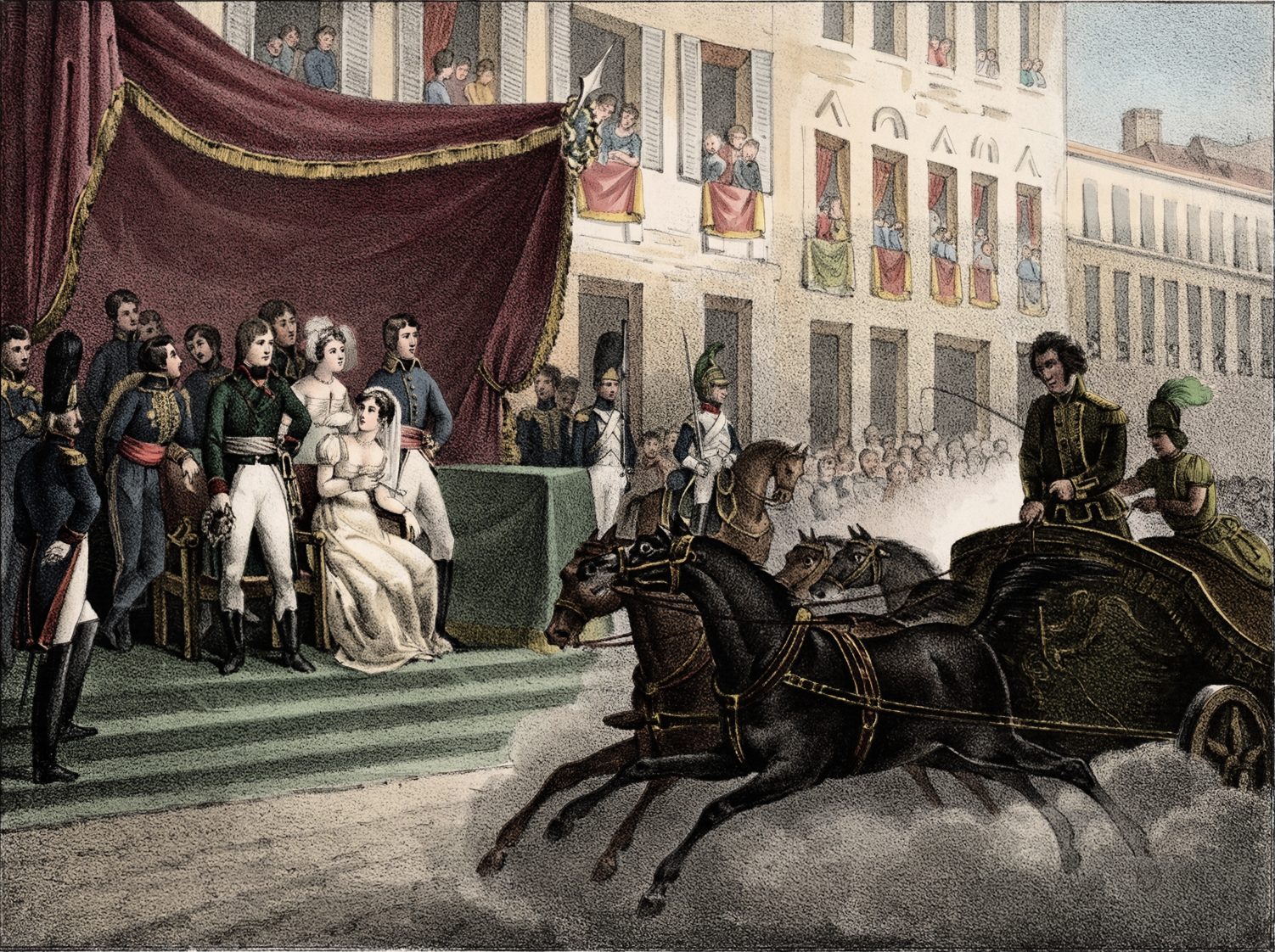 Festivities in Milan: Napoleon and Joséphine at the public games for the founding of the French Republic, probably 1797. Later anonymous German lithograph, ca. 1830.
In 1789, the world Angelo had trained for ended. The French Revolution did not merely shake the aristocracy: it dismantled the entire economy of luxury that had sustained the perfume trade for a century. The men and women who had worn perfumed gloves and carried scented fans were no longer a class. They were a target.
When French troops entered Milan on 15 May 1796, the mood in the streets was, at least at first, close to euphoria. The Milanese intellectuals who had spent decades reading the Encyclopédie suddenly found themselves living inside the republic it had described. Monasteries were dissolved, noble estates redistributed, the guild system that had organized the artisan quarter for centuries abolished overnight. But the excitement did not last. By 1799 Austrian forces had retaken the city, and those who had welcomed the French were now targets. Looting, reprisals, violence in the streets. Within a year the French were back.
What followed was a decade of relative order under a new name. Milan became the capital of the Kingdom of Italy, with Napoleon as king and Eugène de Beauharnais as viceroy. La Scala continued, the city was rebuilt in parts, and a new bourgeois Milan began to take shape around the ruins of the old aristocratic one. But the cost was felt elsewhere: the Continental Blockade from 1806 severed trade routes merchants had relied on for generations, and conscription steadily drained the city of young men. By the time Napoleon's Russian campaign collapsed in 1812, Milan had grown exhausted.
Angelo's brother Nicola kept the shop open through every change of flag. The clientele had changed around him: the aristocracy that had bought perfumed gloves was gone, replaced by a bourgeoisie that wore perfume on skin rather than in accessories. What Angelo had brought from Grasse remained the foundation, but the market it served had become something else entirely. The Habsburgs returned in 1814 to a city that had seen more change in eighteen years than in the previous century.
The Habsburgs returned to Milan in 1814 to a city they could govern but not restore. The revolutions, republics and Napoleonic kingdom had changed something permanently in the way Milanese life was organized, and in who consumed what. A new bourgeois world was taking shape: commercially minded, prosperous, and more open to personal cultivation than the old aristocratic order had been. For a perfume shop on the Contrada de' Pennacchiari, the market had widened.
Nicola ran the business through the long decades of the Restoration, and his son Antonio joined him around 1815. It was Antonio's two sons, another Nicola and another Angelo, the family names passed down as was the custom, who transformed it. They introduced machinery for soap-making and rice-starch powder, the move from craft workshop to small industrial operation arriving at exactly the moment Milan was beginning to industrialize in earnest. Both brothers also married daughters of Bartolomeo Orcesi, a citrus and perfumery merchant who operated elsewhere in the city, binding the family to the wider trade through two alliances at once.
Milan in these decades was not a quiet place. The Risorgimento was gathering force: national consciousness, Romantic literature, revolutionary ideas circulating through cafés and salons. In March 1848 the city rose in the Cinque Giornate, five days of street fighting that drove the Austrians out. They returned. But in 1859, after Solferino, Lombardy passed to Piedmont, and in 1861 the Kingdom of Italy was proclaimed.
The business survived it all. On Nicola's death in 1863, his brother Angelo brought his son Tommaso into the firm. Seven years later, in 1870, the year Italian troops entered Rome and unification was complete, they renamed the house "Angelo Migone and Company." The shop Angelo had opened in 1778 under Habsburg rule now bore his name in a unified Italian state.
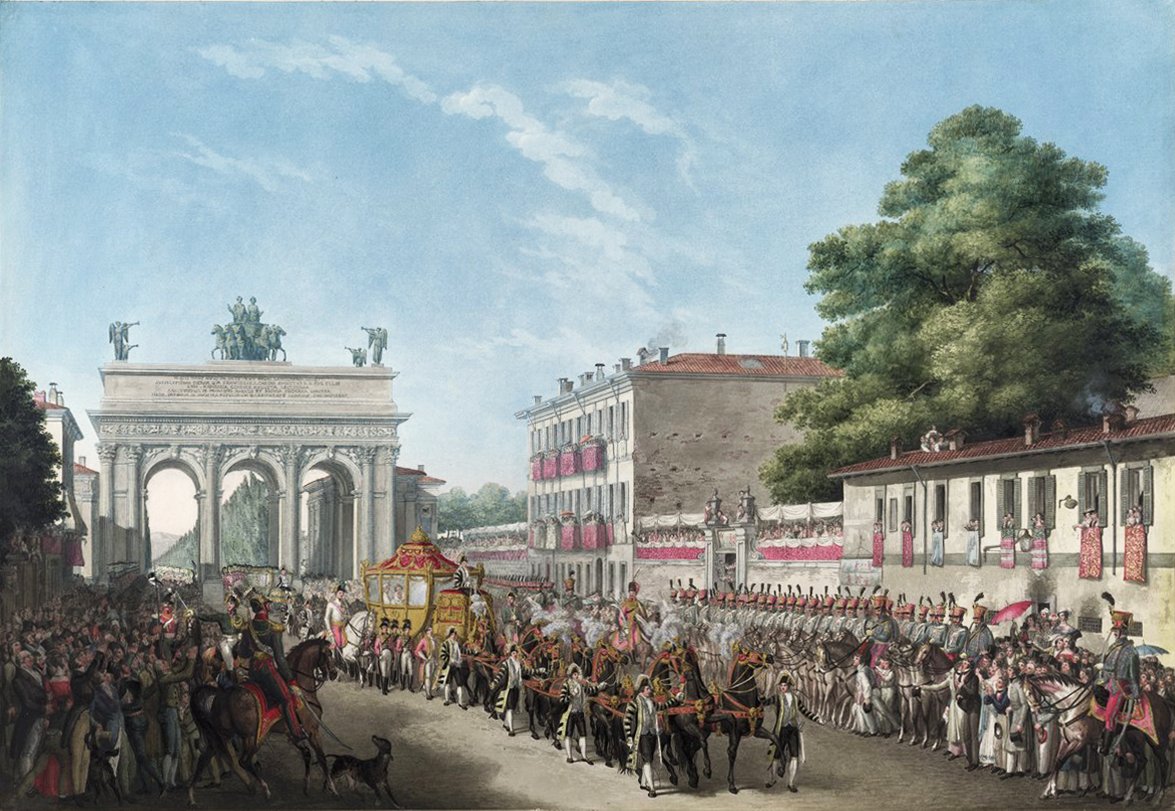 The entry of Emperor Francis I of Austria and Empress Caroline Augusta into Milan, 31 December 1825.
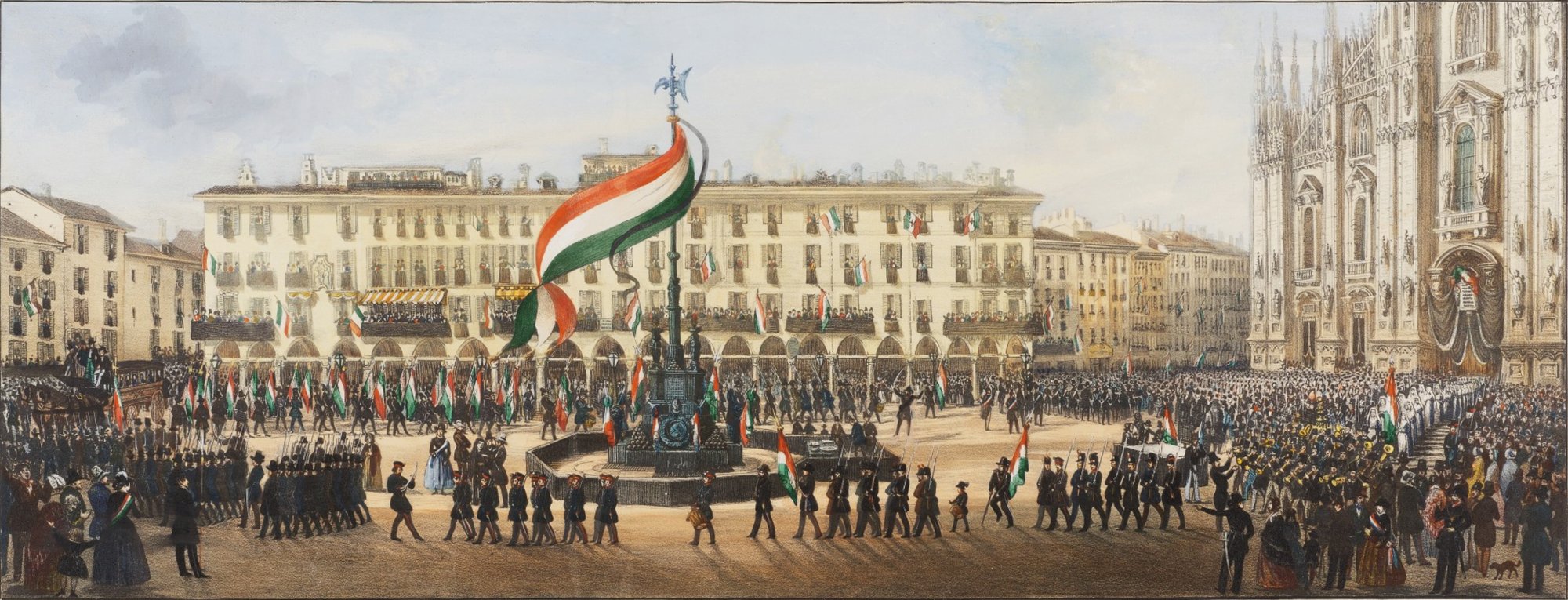 The state funeral for the fallen of the Five Days, Piazza del Duomo, 6 April 1848.
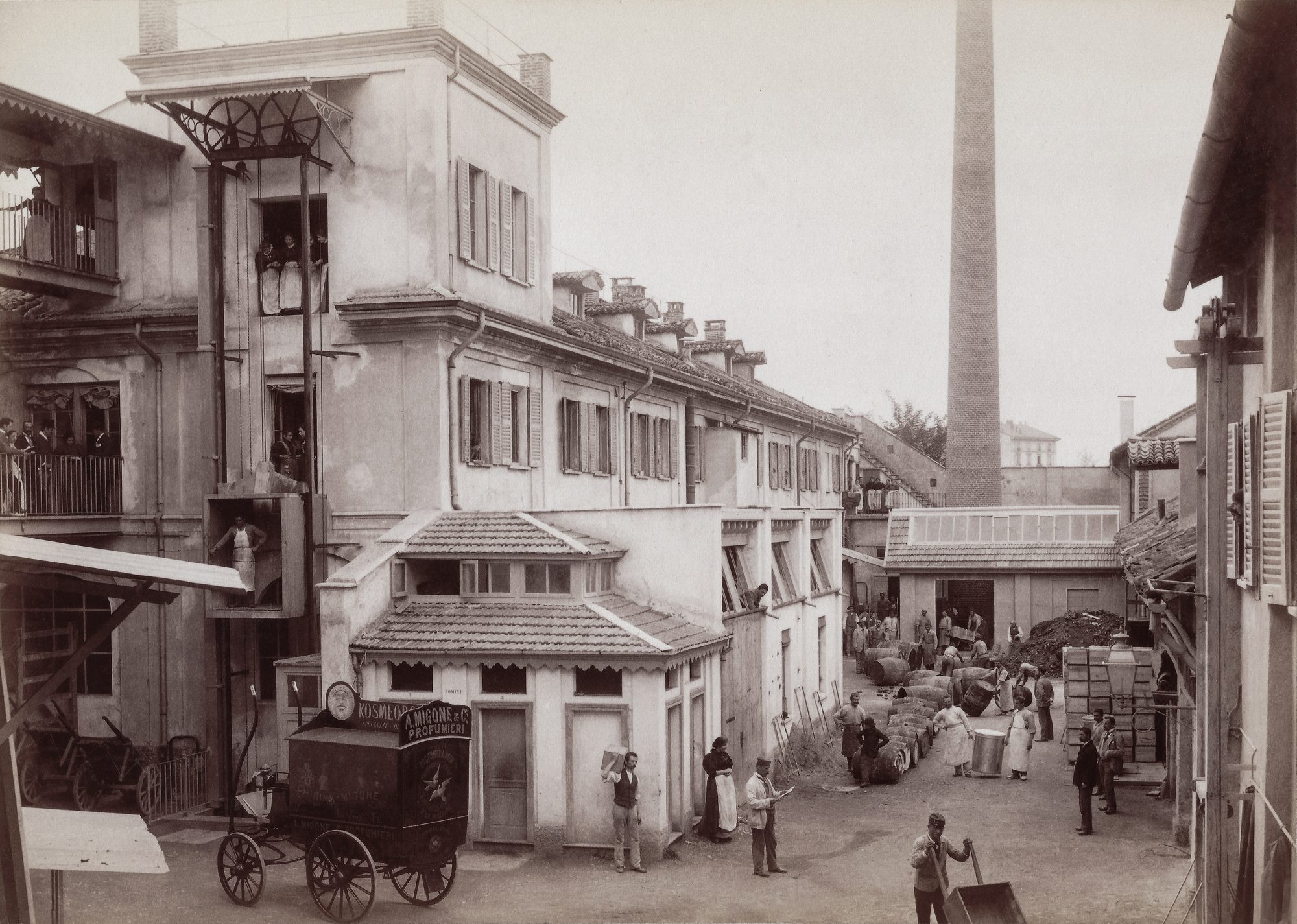 The yard of the Corso Loreto factory, Milan, 1898. A horse-drawn Migone delivery carriage stands at left; the chimney of the steam plant rises behind.
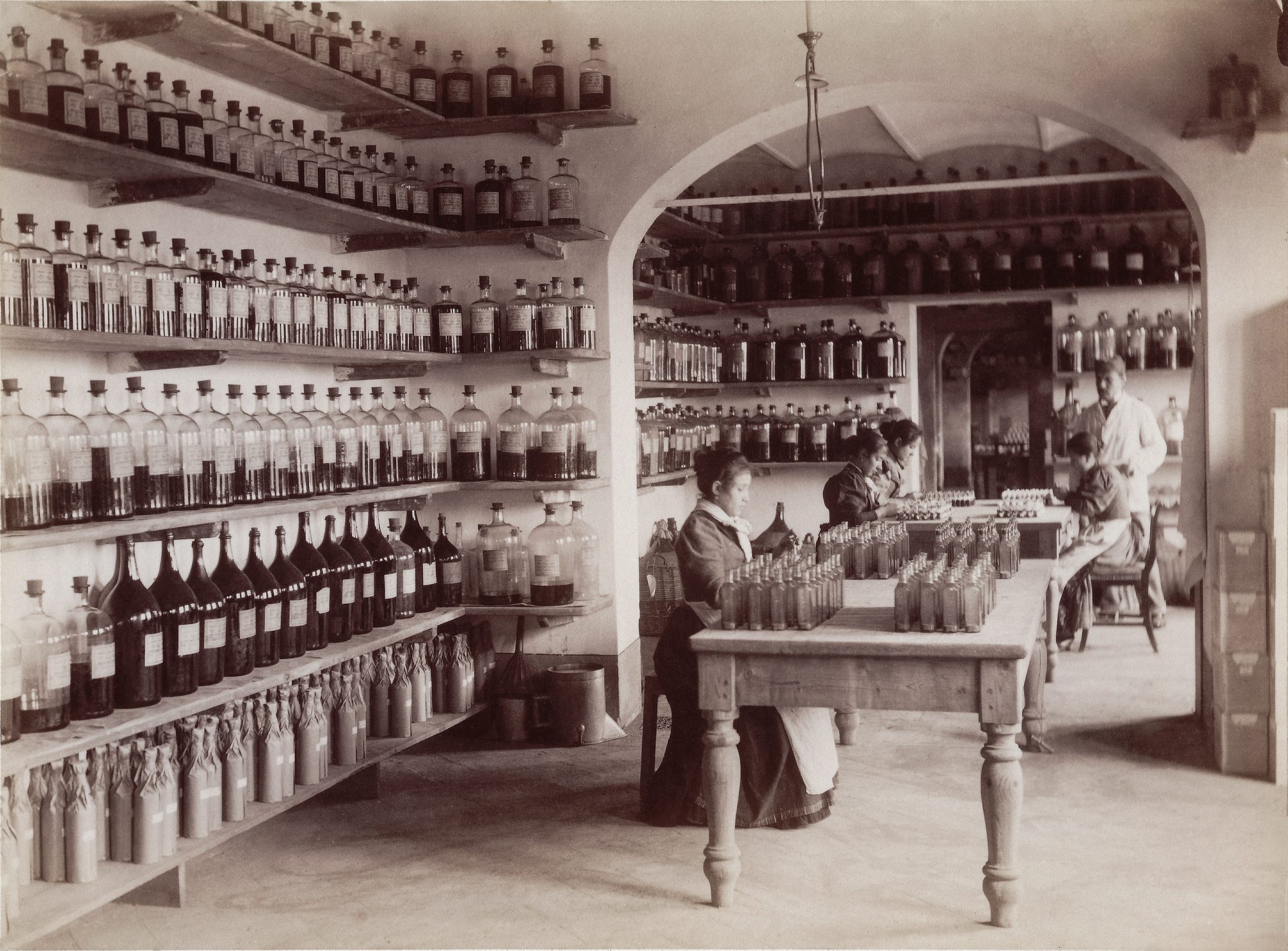 Workers, many of them women, among shelves of essential oils, absolutes, and distillates. The Corso Loreto factory, Milan, 1898.
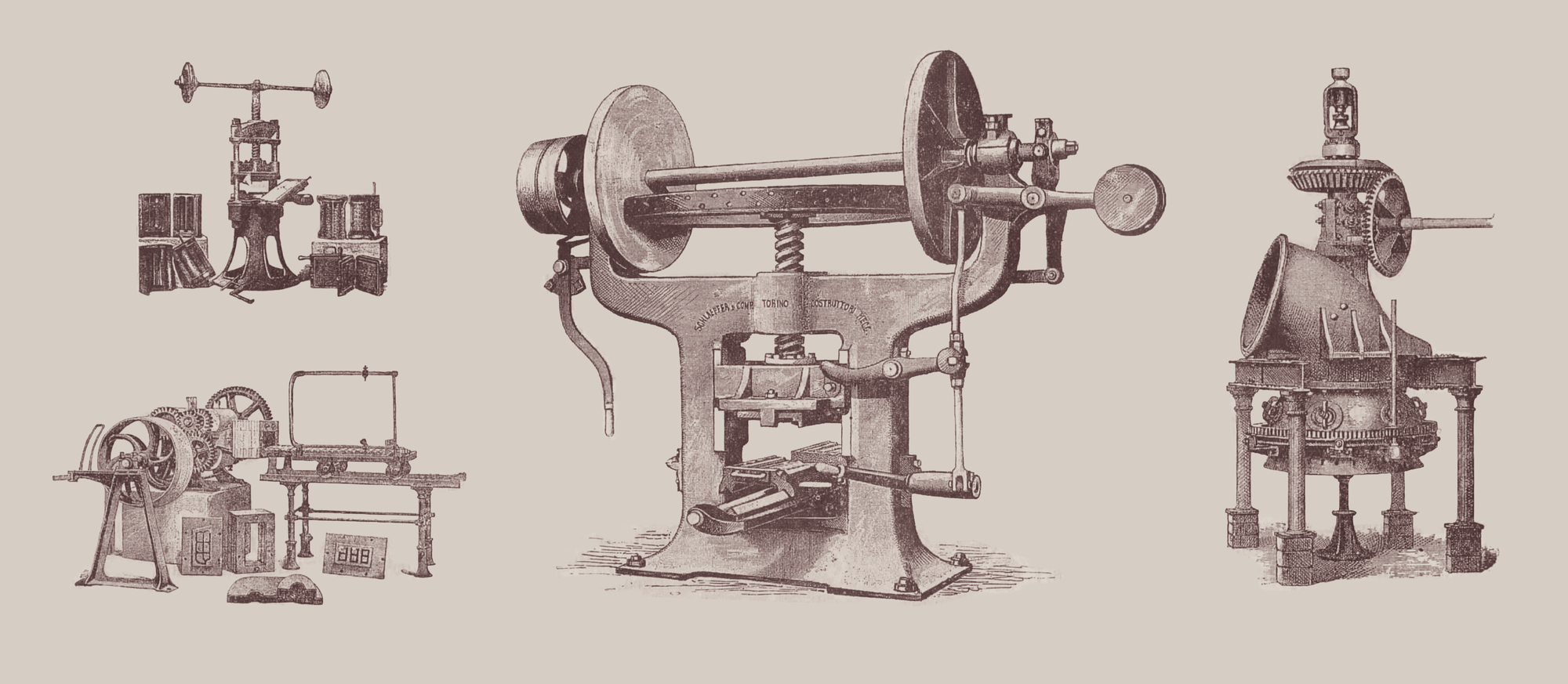 Machinery used by the house of Angelo Migone. Le Panthéon de l'Industrie, 1886.
Milan in the 1870s was becoming a different kind of city. The unified Italian state had opened new national markets, and the railway lines threading out from Milan connected it to all of them. Around the edges of the old city, along the roads pointing outward toward the Lombard plain, factories were rising. Pirelli had set up nearby; Edison would bring electric light to Milan's streets in 1883, the first city on the continent to have it. A new industrial Milan was forming in real time.
Angelo died in 1875, leaving Tommaso alone. He proved a capable entrepreneur: to finance the firm's growth he brought in two outside investors, Magnaghi and Luraschi. Under Tommaso, the shop became an industry.
Around a new factory on what the maps still called Strada per Bergamo, the road out toward Bergamo that was slowly becoming Corso Loreto, he built an operation at industrial scale in a district that would later also include Marelli, Isotta-Fraschini and Alfa. The Migone factory occupied 4,000 square metres, ran two steam engines of 25 combined horsepower, employed more than a hundred workers, and exported to South America, the East, Turkey, France, Germany and England. By 1886 it was the first operation of its kind in Italy. Production ran at Corso Loreto; the shop at Via Torino 12, a few steps from the Duomo, remained the public face of the house.
Between 1871 and 1911 the house won medals at seven international exhibitions, from the Esposizione Nazionale in Milan to the Gran Premio in Turin. By the 1890s the name Migone was on the trams of the city, in its magazines and newspapers, in the calendarietti exchanged as gifts across the country each season. The Acqua di Chinina campaign was, by most accounts, inescapable: there was no Italian newspaper of the era without an advertisement for it. For a house now in its second century, it was a remarkably modern approach to building a name.
That same year the house dedicated a perfumery line to Her Majesty Queen Margherita. It was also the only distiller in Italy of essence of iris from Florence: a kilo of root yielded barely two grams of pure essence, sold wholesale to perfumers across Europe. A craft carried from Grasse a century before had become one of the most significant cosmetics and perfumery operations on the peninsula.
The First World War transformed industrial Italy, and Milan with it. In those years the shop moved from Via Torino to Via Orefici. The building that had housed it for nearly a hundred and fifty years came down between 1923 and 1925. Its interior courtyard, with arcaded loggias, quattrocento terracotta tiles, and granite columns, had survived intact until the end: it was photographed before the wreckers arrived, and what remained of its carved stonework is held today at the Castello Sforzesco. The firm became "Successori Angelo Migone & C.," then "Soc. Anon. Migone & C.", now a Società Anonima with shareholders and capital of its own.
Fascism imposed its aesthetic on every aspect of public life, but Migone's products continued to circulate in a market that outlasts regimes: perfumes, soaps, face powder, cosmetics, responding to needs that regimes do not cancel. In 1943 Milan was bombed. The shop on Via Orefici and the factory at Via Ripamonti 133 survived.
On 2 June 1946 Italians voted for the Republic. The Savoyard monarchy was abolished. The Italy rebuilding itself after the war was something new: Vespas on the streets, cinema in every quarter, the first stirrings of the miracolo economico. In 1955, a hundred and seventy-seven years after Angelo first opened his shop, Casa Migone closed. Eight governments: two Austrian, four Napoleonic, one Savoyard, the Republic. One house.
What it built did not disappear. The brands, the formulas, the visual language of Italian grooming, the medals and the catalogues and the photographs: these are what the Fondazione Migone now holds, documents, and protects.
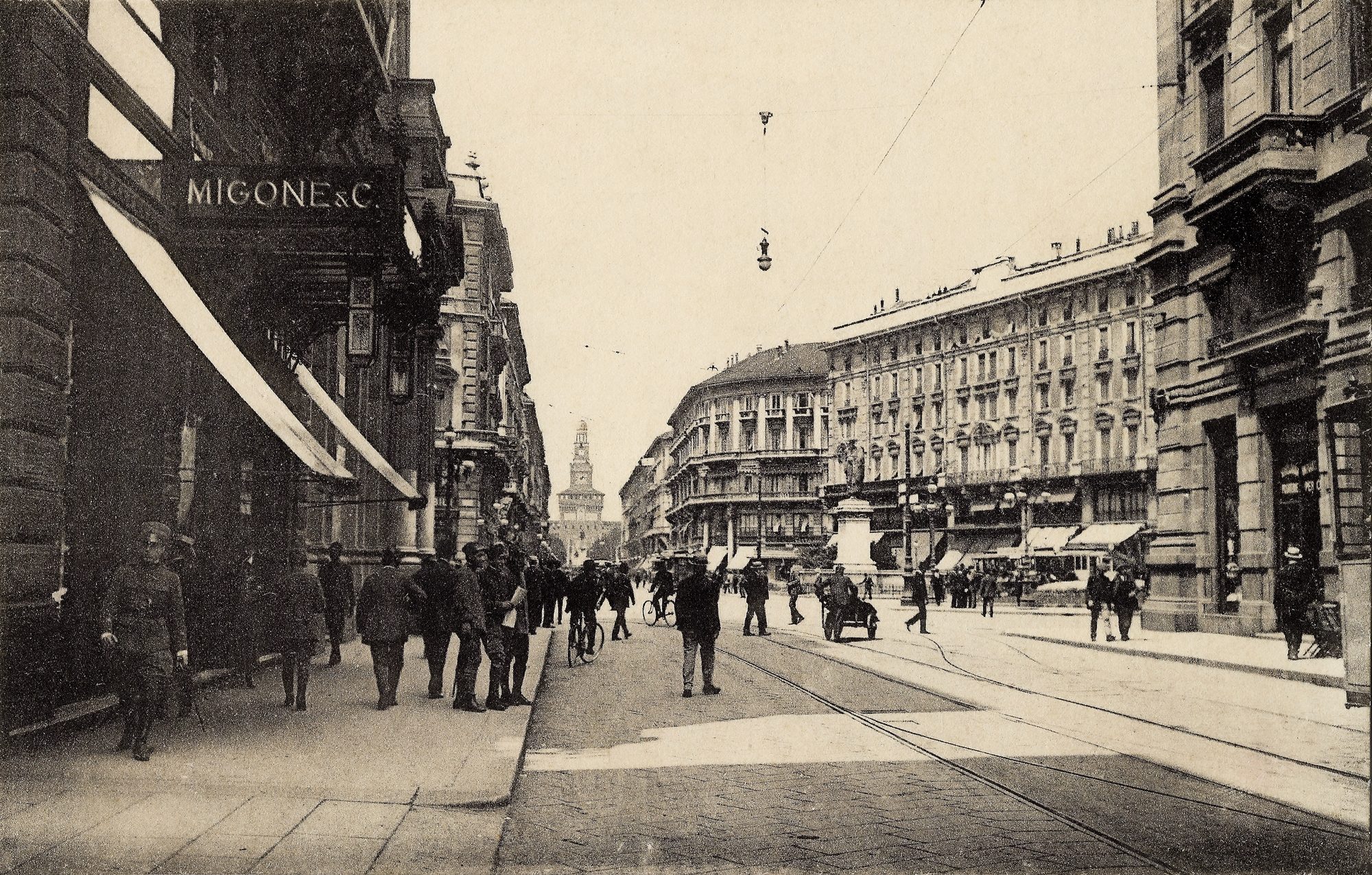 The Migone & C. shop at Via Orefici, Milan, looking down Via Dante toward the Castello Sforzesco.
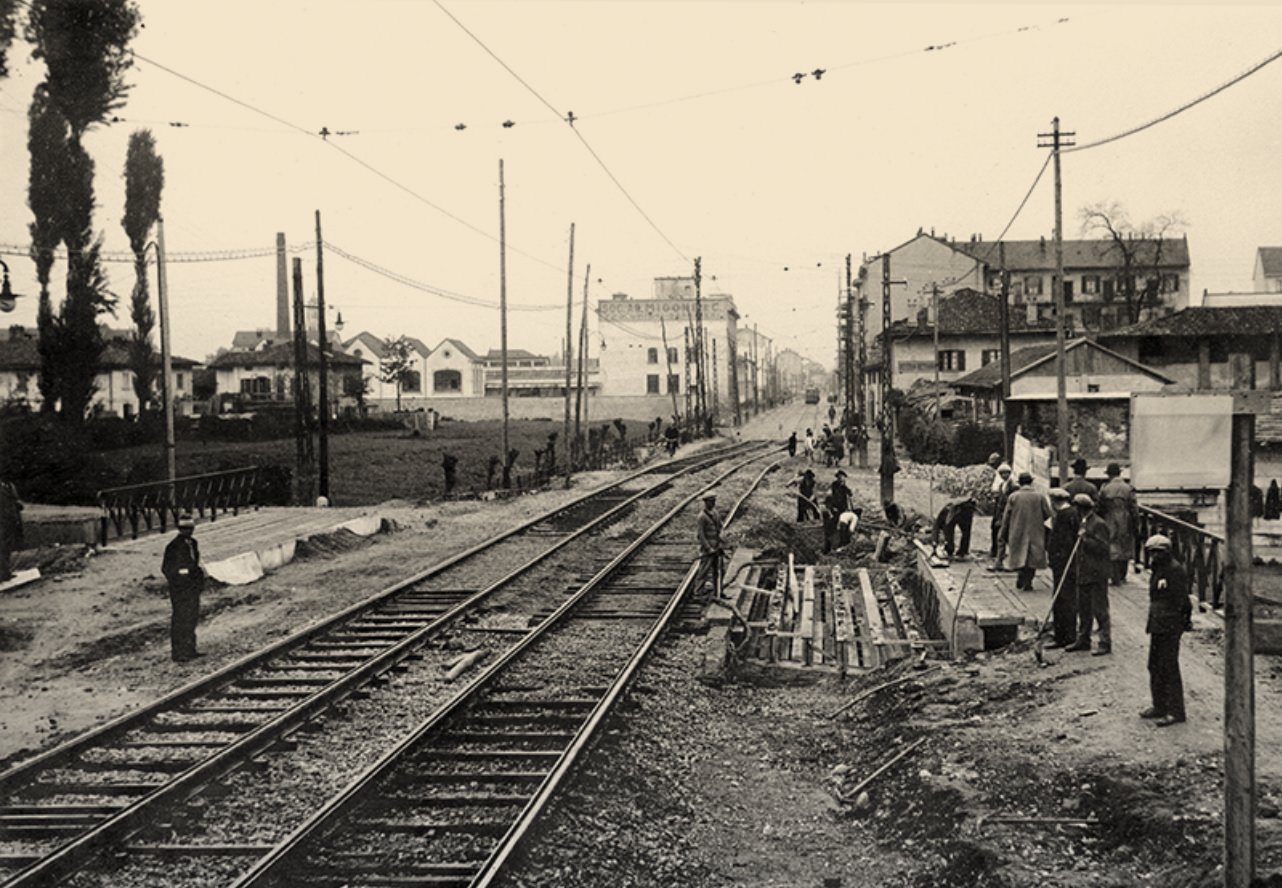 The Migone works on Via Ripamonti, on Milan's southern edge, 1931. The factory, lettered ‘Soc. An. Migone & C.,’ stands mid-distance beyond the tracks.