
Every move the house made tracked a transformation of Milan: from the edge of the old walls to the medieval heart of commerce, from the industrial frontier of the nineteenth century to the luxury quarter of the new one, to the large southern factory of its final decades. Four premises. Almost two centuries. A city that never stopped growing, and a house that grew with it.
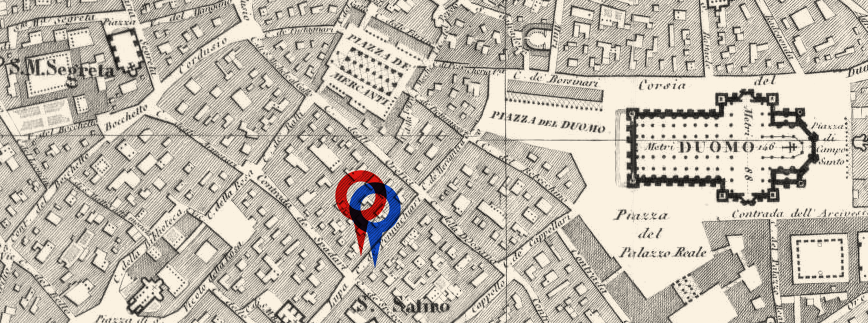 The Contrada dei Pennacchiari by the Duomo, with the two Migone civic numbers, 3233 and 3232, marked in red and blue.
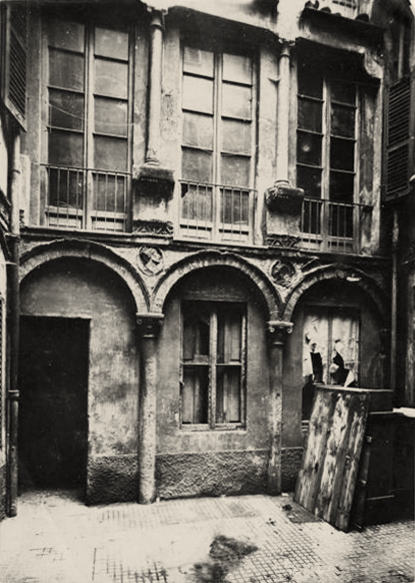 The Renaissance courtyard behind Via Torino 12, photographed before its demolition in 1923–25, its arches set with quattrocento terracotta roundels. Osvaldo Lissoni, in E. Verga, I monumenti di Milano minori e minimi, Milan, 1927.
Milan in 1778 was still a city you entered through gates, ringed by the broad Spanish ramparts that had held its shape for two centuries. Angelo Migone founded the house that year, in their shadow, out at the edge of things. But a perfumer's trade belonged to the centre, and the house soon took root in the oldest heart of the city: the Contrada dei Pennacchiari, a narrow lane of feather-makers running down from the Duomo, the first stretch of what is now Via Torino.
The quarter he entered was a medieval survival, where every lane wore its trade like a name. The Pennacchiari cut the plumes for hats, helmets, and funeral horses; a few doors on stood the swordsmiths of the Spadari, the goldsmiths of the Orefici, the perfumers of the Profumieri. It glittered, but it was no genteel address. The Pennacchiari ran straight out of the Contrada della Lupa, the quarter the Milanese called simply la Canaglia, the rabble, after the rough alleys packed within it and the wolf's head still carved on its corner house. The Malastalla, the debtors' prison, stood close by. Here a perfumer's fine shop and open poverty shared the same wall, on streets laid over Roman stone and watched by churches raised in thanks for surviving the plague.
The Migones held to this one lane for well over a century, and barely moved along it. Angelo and his brother Nicola kept number 3233, close to the Spadari corner. It was a crowded address: the family shared it with tailors, chocolate-makers, an accountant, and a trattoria, a whole working world under one roof. The next generation crossed to the building directly opposite, number 3232 by the Speronari: Antonio, Nicola's son, and after him his own sons, Nicola and Angiolo. The family stayed on, generation after generation, as the quarter changed around them. In 1861 the lane took the name Via Torino, for the first capital of a newly made kingdom, and by the century's end the shop bore the number it would keep until 1913: Via Torino 12. By the 1880s its luxurious windows there were a Milanese fixture, the sort passersby stopped in front of.
Behind the shopfront lay something few passersby would have guessed at. The courtyard was a small Renaissance monument, ranked by nineteenth-century architects among the finest early courts in Milan: three tiers of round arches on slender columns, their capitals close kin to those Filarete carved for the Ca' Granda, the city's great hospital. Everything was warm brick and modelled terracotta, egg-and-dart mouldings and portrait medallions set into the arches. It was already slipping away by the 1800s, "in part destroyed and disfigured," and the last of it fell when the block came down between 1923 and 1925.
In the 1870s this road was still called "Strada per Bergamo" and ended outside the city walls. The Spanish walls were coming down section by section, and Milan was spilling outward with an industrial energy that knew no pause. Factories, workshops, smokestacks: everything the dense old city could no longer contain moved out here, beyond Porta Venezia. The street saw every stage of the city's transit in turn: horse-drawn trams, then the steam line that puffed out toward Monza from 1876, and, by the 1890s, electric trams, with Milan among the first cities in Europe to run them. Within a decade the road had become one of the densest industrial corridors in Italy: Pirelli, Edison, Marelli, Isotta-Fraschini, Bianchi, and Alfa were all within a few blocks of one another.
When the French journal Le Panthéon de l'Industrie rode out by tram to visit in 1886, it found a working factory of real scale: a four-thousand-square-metre site beyond Porta Venezia, more than a hundred workers, steam engines turning the machinery. Toilet soap was milled, coloured, perfumed, and stamped by the caseload; the ground-floor packing room stood stacked with crates bound for South America, the East, and Turkey. Four travelling salesmen carried the house's goods, three through Italy and one abroad, and in one thing the factory stood alone in the country: it was Italy's only distiller of iris essence, which it shipped on to the great wholesale perfumers of France and England.
By the end of the century the works looked like the future. In photographs of the Corso Loreto offices from 1898, electric lamps hang overhead, a telephone waits on the wall, and men and women work side by side at rows of desks, something still rare anywhere in Italy. Below, in the arcaded courtyard, the day's crates were loaded onto carts for dispatch. It was a house well over a century old that insisted on being modern.
In 1906, for the International Exhibition, the city renamed Corso Loreto as Corso Buenos Aires, in tribute to the Argentine city that was absorbing hundreds of thousands of Italian emigrants each year. Naming one of Milan's great industrial arteries after their destination was a recognition, almost a tribute. It was the same street, not two separate premises. The shop stayed in town; the factory was here, beyond the walls.
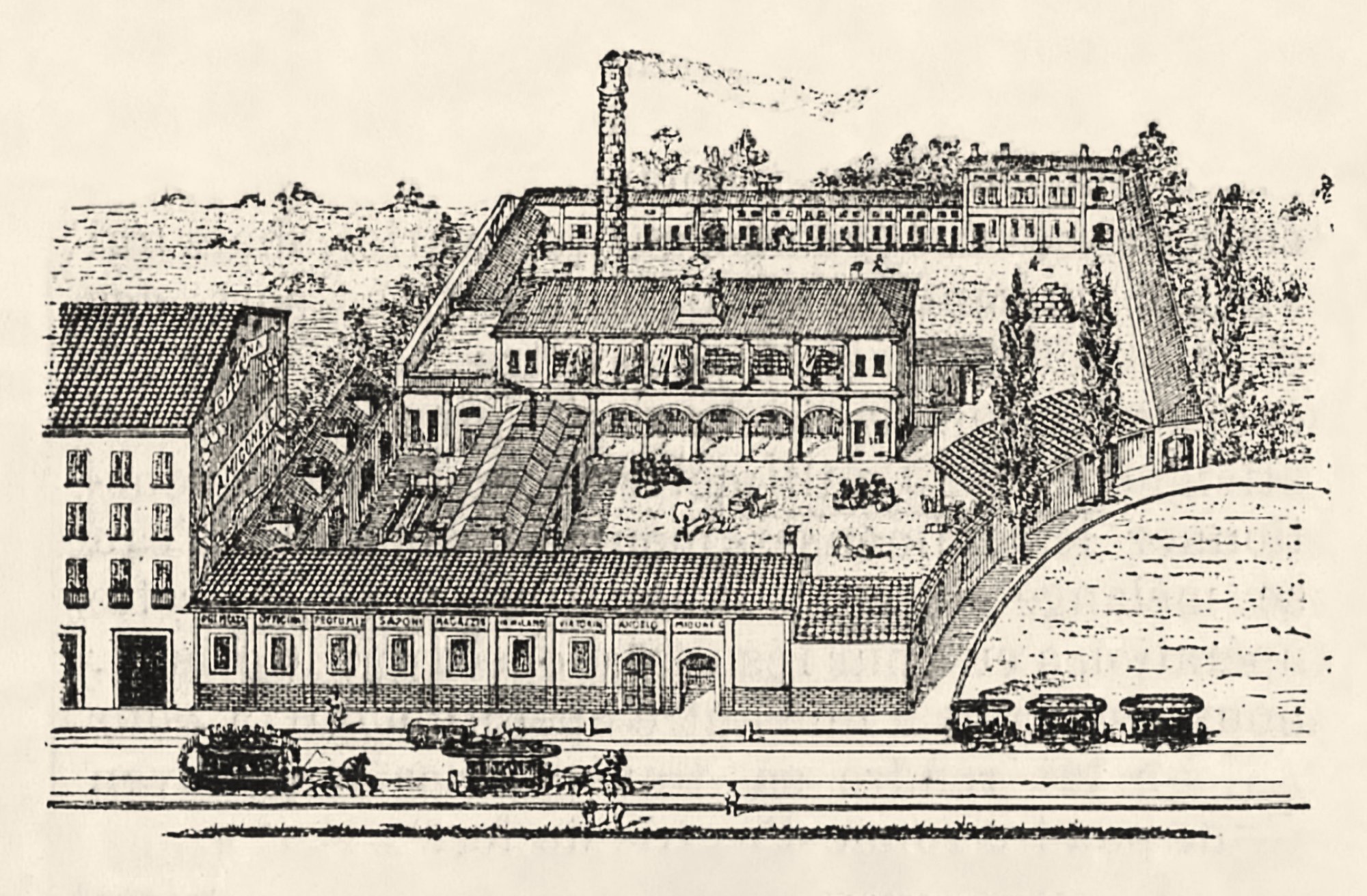 Migone establishment, Corso Loreto 97, Milan, 1886.
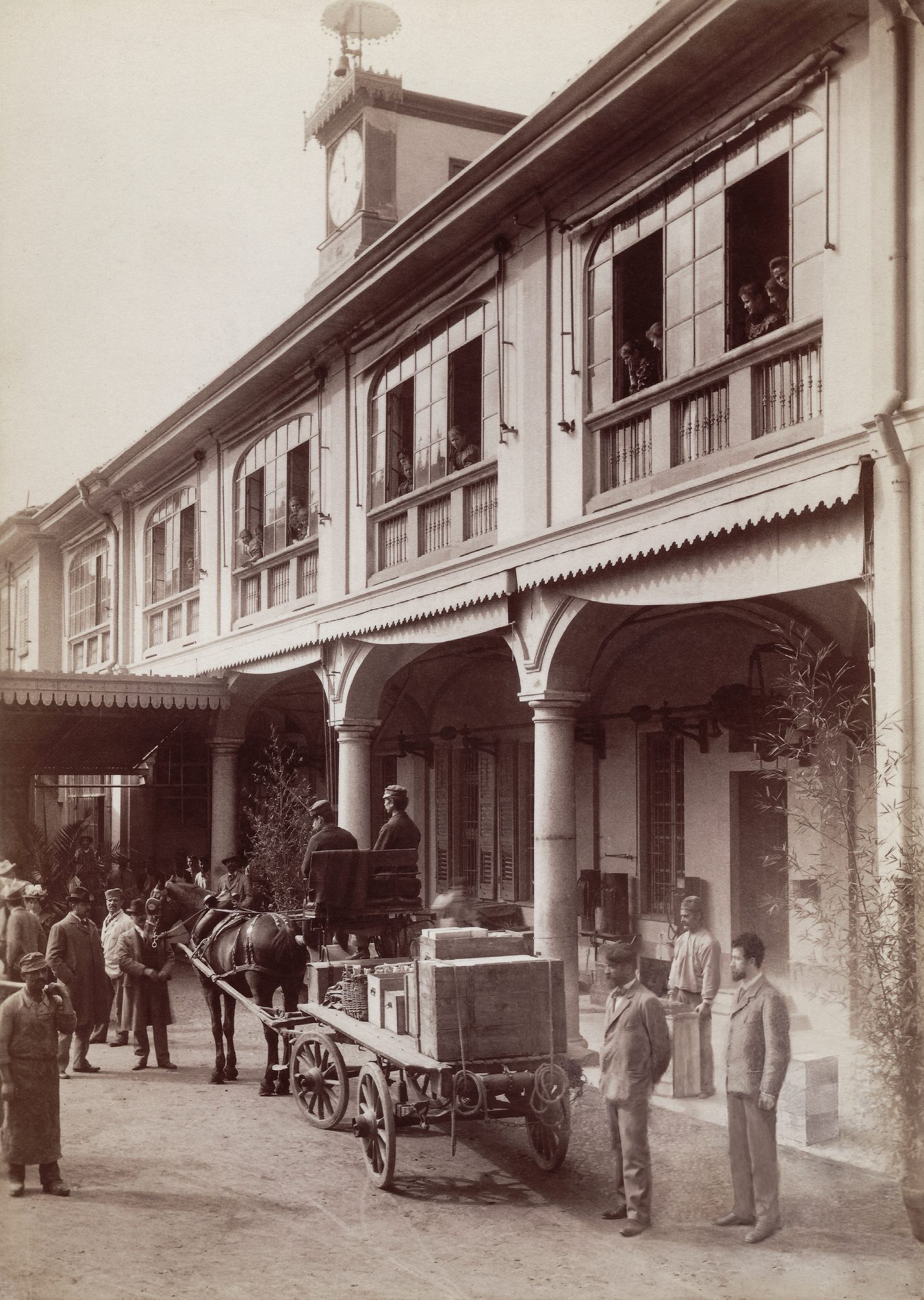 The courtyard of the Corso Loreto works, Milan, 1898. A delivery cart is loaded with crates under the arcade; above, staff look on from the factory windows.
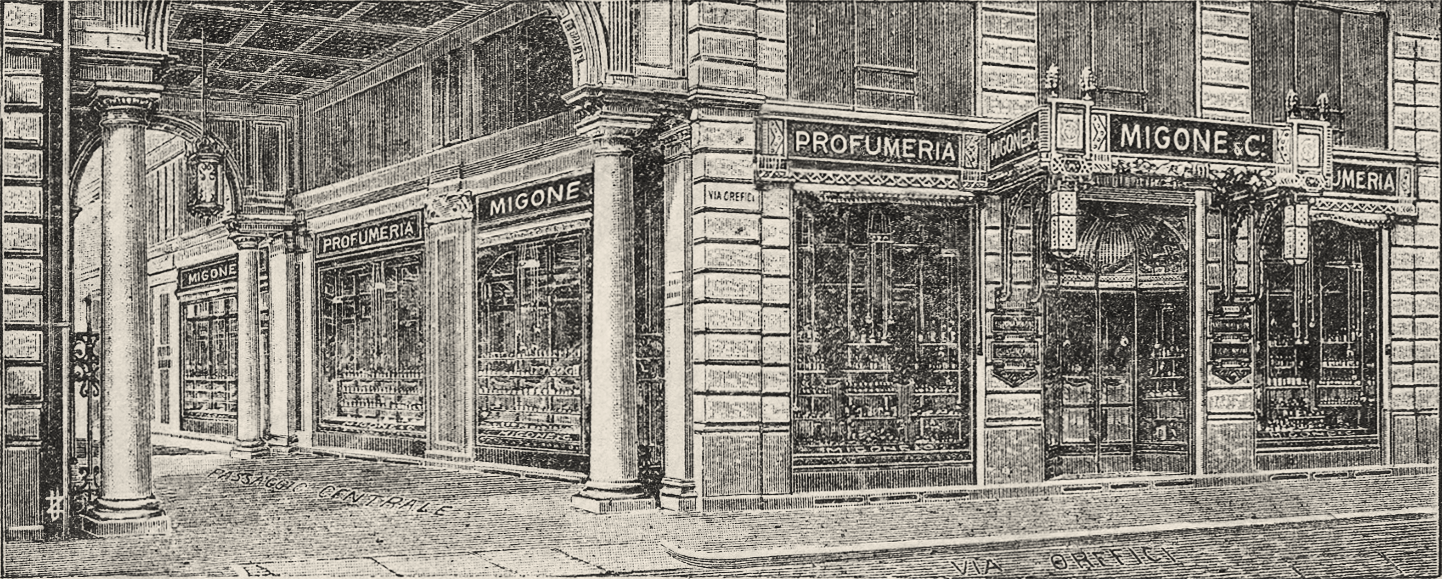 The Migone & C. profumeria at the corner of Via Orefici and the Passaggio Centrale, Milan, its windows lining both the arcade and the street.
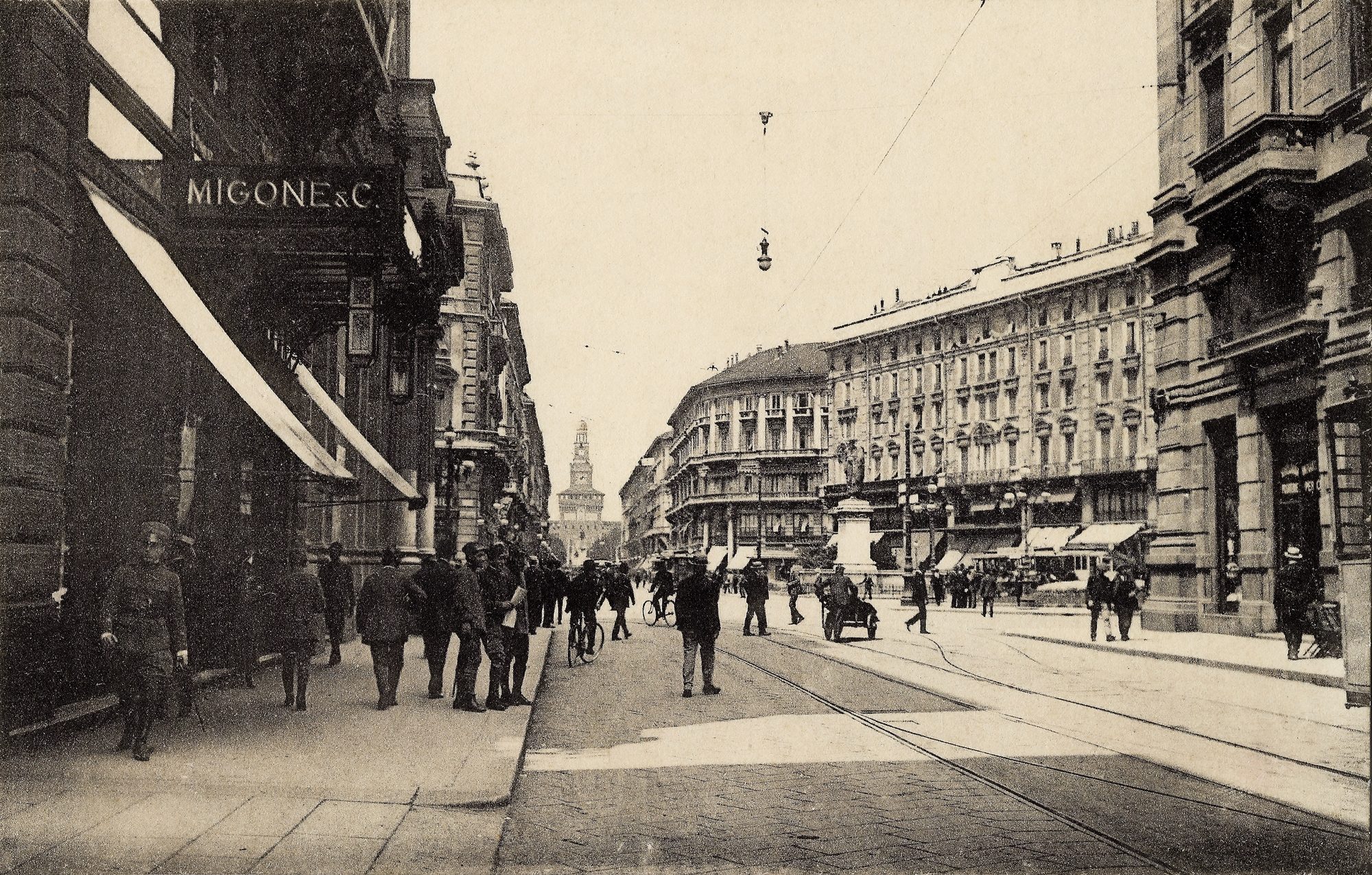 The Migone & C. shop at Via Orefici, Milan, looking down Via Dante toward the Castello Sforzesco.
Via Orefici had been the goldsmiths' street since the Middle Ages, one more medieval lane named for its trade. By the time Migone arrived, it was almost unrecognisable. The Galleria Vittorio Emanuele II had opened a few steps away in 1877, its architect Giuseppe Mengoni falling from the scaffolding days before the ribbon was cut, and overnight it became the most coveted address in Italy. Then, through the 1890s, the old lane itself was torn open and rebuilt, widened into a broad modern street of fresh stone that ran down to Piazza Cordusio, the grand new banking quarter Milan was raising out of its medieval centre. The ancient street of the goldsmiths had become one of the newest in the city.
The house took its shop into the Passaggio Centrale, a covered arcade beside the Galleria, in 1913. It was a statement. The small family workshop of 1778 had grown into a modern firm, with partners and outside capital and a founder's name that now stood for a brand more than a man, and it planted its window at the very centre of the new commercial Milan, steps from the Duomo, the Galleria, and the banks of the Cordusio. The factory stayed out beyond the walls; the public face of the house belonged here, in the heart of things. It was 1913, on the eve of the First World War, which would remake the world the house had been built for.
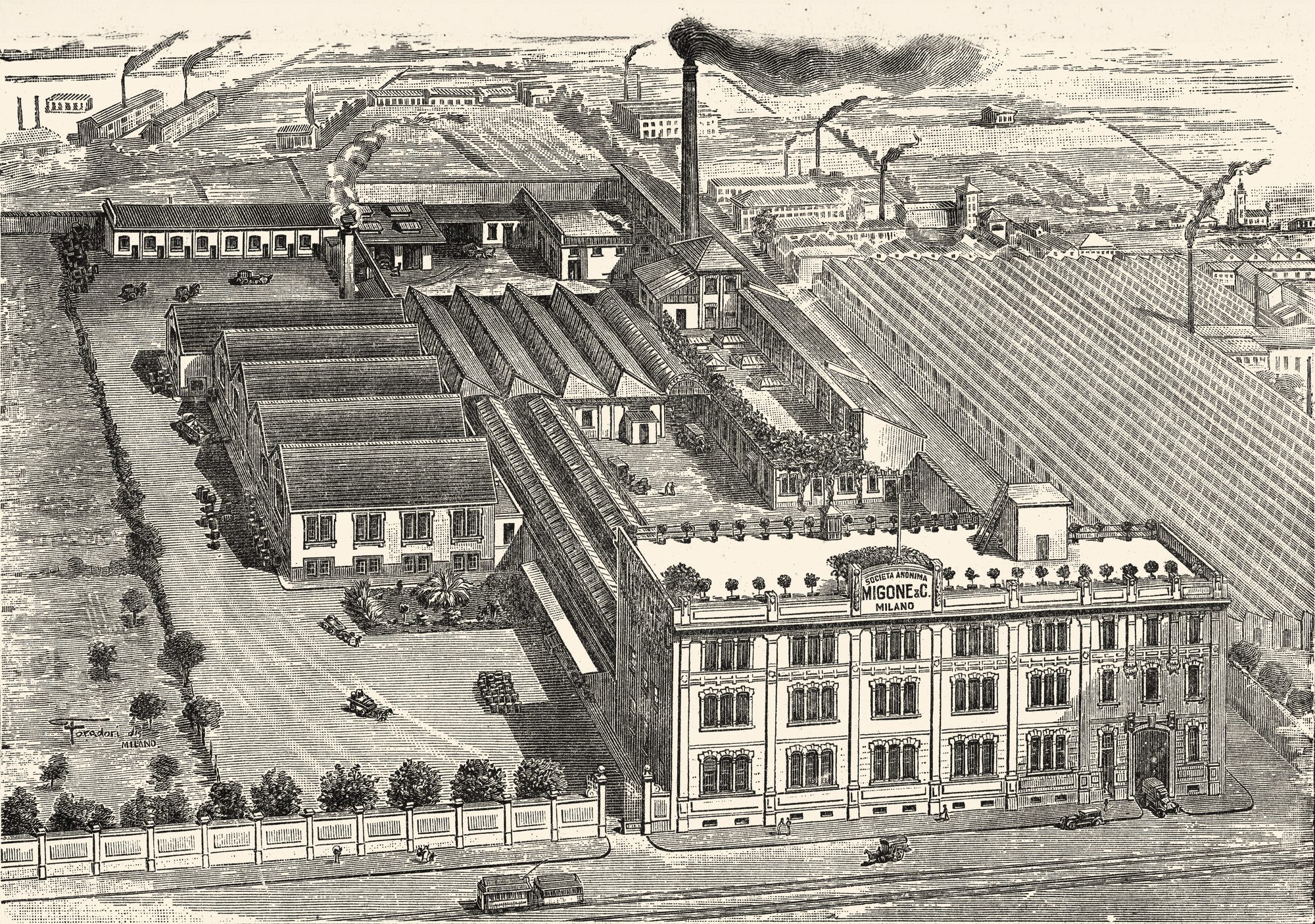 The Società Anonima Migone & C. works at Via Ripamonti, Milan, seen from above: saw-tooth workshop roofs, the steam-plant chimney, and the office frontage along the street.
To the south, the Naviglio Pavese canal ran alongside Via Ripamonti toward the Pavese countryside in a landscape still mixed with farmsteads, workshops, and new workers' districts. This was Milan's southern frontier: expanding in every direction through demolitions in the centre, new construction at the edges. The same years in which the block on Via Torino was being torn down.
Around 1930 the house moved its factory here, into a larger premises than it had ever held at Corso Buenos Aires. The shop on Via Orefici stayed open; Via Ripamonti was where things were made. The telegraphic address was MIGONCHINA, after the house's most enduring product.
From these sheds south of the city, Migone's creams, soaps, and waters went out to the world. The house had been exporting since the 1880s, to South America, the Levant, and Turkey; by the 1930s it had crossed the Atlantic, selling in New York. A house born in a walled, eighteenth-century Milan had reached the shelves of the American century. The factory ran on until the house itself closed, in 1955.