
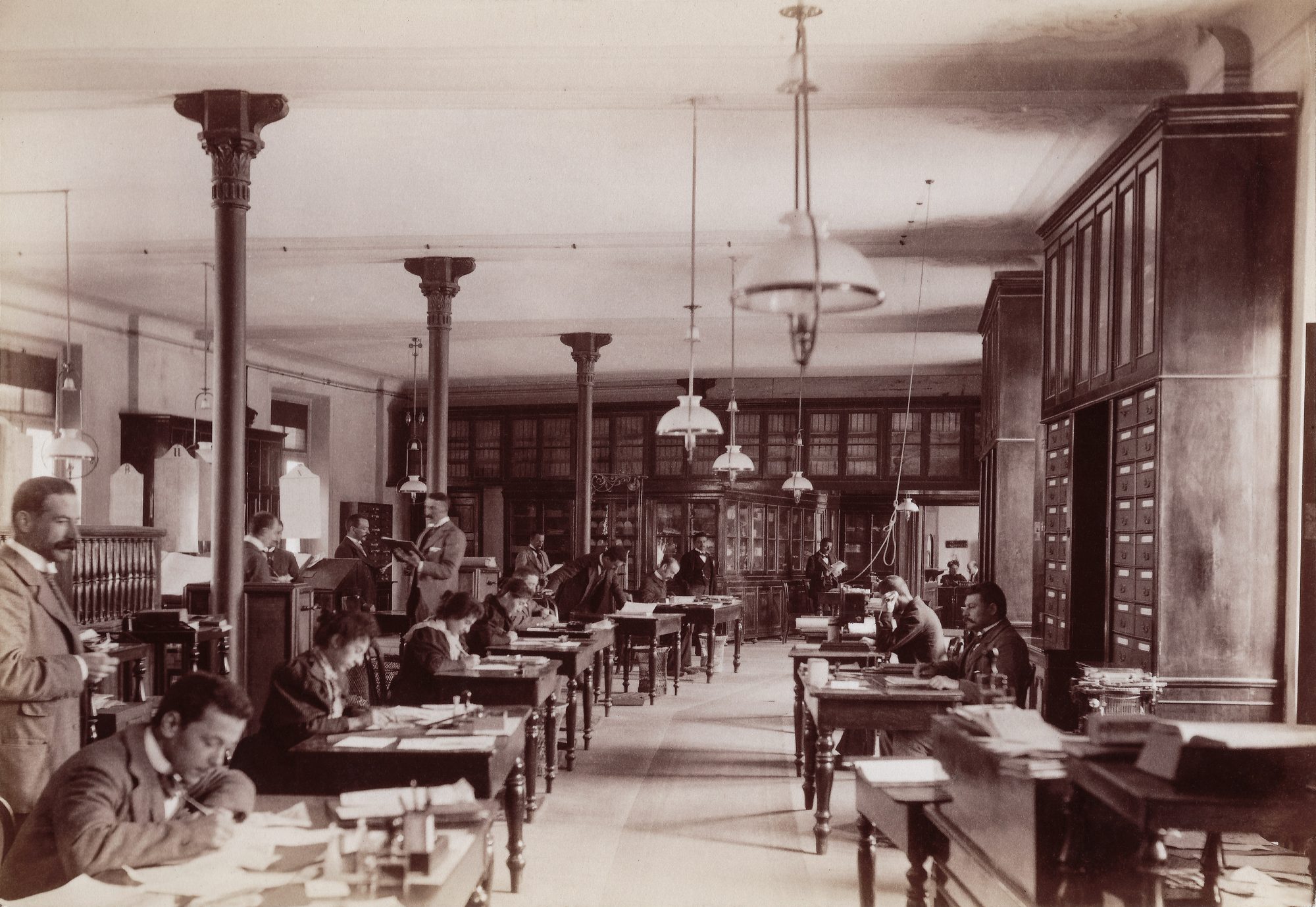
The Migone offices on Corso Loreto, photographed in 1898: electric pendant lamps overhead, men and women working side by side at rows of desks (still far from the norm) and, if you look closely, a figure at the telephone. These are not incidental details. They are a portrait of a company embedded in a city that, fifteen years earlier, had become the first in continental Europe to equip itself with a public power station.
Milan's first experiments with electric lighting date to 1877, when the engineer Giuseppe Colombo installed a trial electric beacon in Piazza del Duomo. The result was unimpressive compared with the gas lighting already in use, and further attempts followed in 1879 and 1881, the latter for the Esposizione Nazionale di Milano, with arc lamps installed in the Galleria Vittorio Emanuele II. Migone was among the exhibitors that year and took home a medal: the house and the new light competing for attention in the same halls.
The turning point comes after Colombo visits the Exposition Internationale d'Electricité in Paris in 1881, then travels to New York in August 1882 to study Edison's Pearl Street power station firsthand and arrange the supply of electrical machinery. On 28 June 1883, Milan's first Italian thermoelectric power station is inaugurated on Via Santa Radegonda, a few steps from the Cathedral: the first in continental Europe, after London's (Holborn, June 1882) and Manhattan's (Pearl Street, September 1882).
The station immediately powers the elegant shops under the arcades of Piazza del Duomo and the Galleria, including Caffè Biffi and the Bocconi department store, now La Rinascente, and the Teatro Manzoni. From late 1883 the station also lights the Teatro alla Scala, making it the first opera house in the world to be illuminated by electricity. On 26 December, for the opening night of Ponchielli's "La Gioconda," the audience sits beneath 2,450 electric bulbs for the first time in history. There is a coincidence worth noting: La Scala had opened its doors in 1778, the same year Angelo Migone first opened his shop. One hundred and five years later, both found themselves at the frontier of a new age. The Santa Radegonda station remains in operation until 1926, when the building is demolished to make way for the Cinema Odeon.
The telephone arrives in Milan in those same years, in fact ahead of electric light: on 30 December 1877 the Gerosa brothers complete the first Italian telephone connection, between the Pompieri Civici headquarters in Palazzo Marino and the depot of the Società Anonima degli Omnibus, outside Porta Venezia. In 1884 Milan's various operators merge into the Società Telefonica Lombarda.
By the time someone photographs the Corso Loreto offices in 1898, street lamps and telephone wires are already an ordinary fact of urban life: the same city where Casa Migone sold its perfumes was, quite literally, lighting itself and wiring itself together.
← Back to the Journal